
Auction Donations
We are collecting Auction Donations through May 13th.
Mark your calendars for the Online Auction to go live May 27th.
Defense Against Trafficking
We are collecting Auction Donations through May 13th.
Mark your calendars for the Online Auction to go live May 27th.
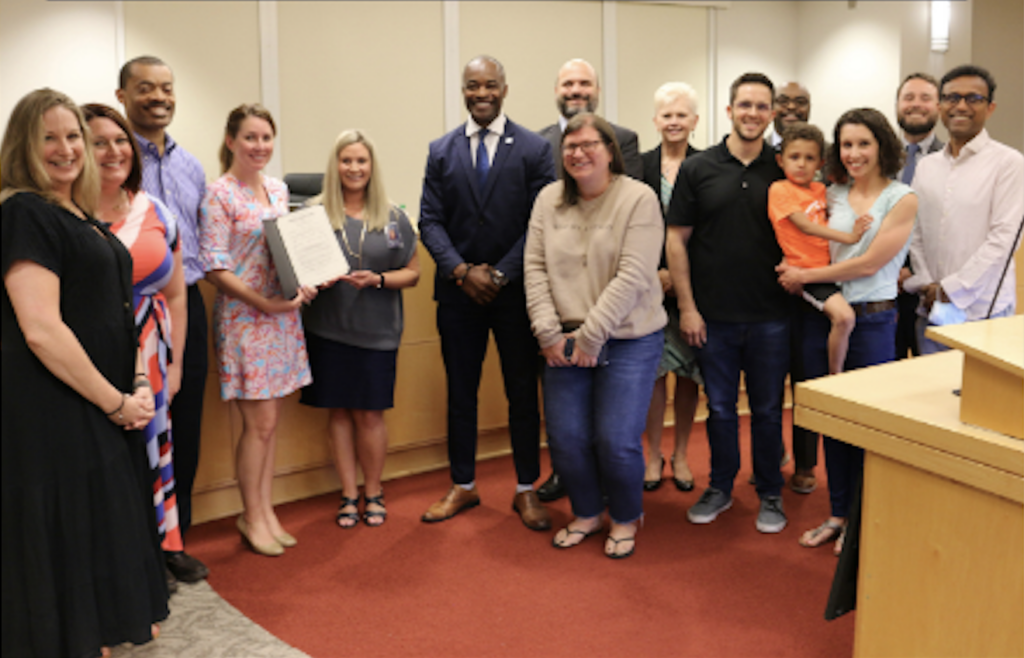
Mayor Gilbert presented Shield NC with a proclamation for May to be officially “Foster Care Awareness Month” for the Town of Apex.
The Service Groups and Faith Alliance has been focused on empowering leaders with information about child abuse prevention and foster care in our area.
Shield NC has also continued to co-lead the NC Demand Reduction Task Force and has made strides to better tackle the driving force of trafficking.
Shield NC has offered multiple trainings to empower professionals to fight against human trafficking.

Only 25 Tickets left!
#65 Per Person
The Dock at Seaboard Station
Corporate Sponsor Opportunities Still Available
Service Groups and Faith Alliance
February 15, 2022
Meeting Minutes
Attendees:
Nicole Bernard, Niki Miller, Ofc Kenneth Ragland, Jim Ahler, Steve Purucker,
Britney Williams, Kim Adcock, Robert Stevenson, Danica, Nancy Hagan, Ginger Espino, Elliot Brooks, Cheryl Stallings, Michael Merker, Deb Vinci
Introduction
Officer Raglan provided overview of how these meetings began and the purpose. Round robin to introduce attendees.
Niki – Rotary International has redefined their mission to include combating Human Trafficking.
Update: Representatives of the Service Groups and Faith Alliance began discussions with Town leaders to develop a way to formalize a system that would connect our group to community member’s requests for help, to assure that no needs of the community fall through the cracks.
Notes
Kim Adcock Presented:
She asked us to close our eyes and think about what ‘home’ means to us. She then took us on an imaginary journey of being removed from our home and placed in the home of a new family. She had us imagine what being uprooted and moved might feel like. It was a great exercise to better understand what a child goes through when they are moved into a foster home.
Kim asked for feedback from this exercise from the group: The group felt this was valuable to help set the stage.
Any type of support is needed and helpful at any level.
Wake County Child Welfare Foster Parent Program presentation:
Who’s in care: 477 children
Where:
126 in Wake Co. Foster Homes
169 in NC but outside Wake
125 outside of Wake or NC (requires changing schools, church, recreational activities, siblings disconnection)
One Church One Family Model
This model keeps children in their community and minimizes the adjustment needed
There are 17,000 churches in NC and 2000 in Wake County.
If every church has one foster family, all children would stay in their home community
What Can We Do:
Q&A
Robert from Rotary volunteered to round up suitcases to donate. They also have capacity to transport items and deliver them where needed.
Kenneth said they could drop off at the Apex PD and then Kim has a place in main building to store items
Jim Ahler – personal hygiene, suits, and clothing for children for interviews, how to shop for these clothes (gift cards), suitcases
How to support a family that choses to foster:
Kim described how churches can bring interested congregation members together to support a family when the family decides to foster.
Birth family:
Social Worker must meet with them twice a month
Any needs are directed by the Social Worker
Birth parents can visit once a week with their children and have phone calls; foster parents assist with how to communicate and/ or help with homework, etc
Emergency removal in crisis situations- Placements are needed for short term
Cheryl: staffing on Kim’s end. Social Worker assigned to child also works with birth family
Ginger: Aces 101 workshop would be helpful for working with foster children
Action Steps:
Talking with any organization or friends/family about the needs; how or who you can connect with
Collect supplies
Perhaps post on social media
Don’t wait but act while its fresh
Other updates
Jordan Lutheran – to collect items in May
Info session May
Hope Chapel, Peak, The Point are in conversation
Service Groups and Faith Alliance
Attendees:
Nicole Bernard, Niki Miller, Robert Cunningham, Jim Ahler, Ginger Espino, Patrick Jones, Cheryl Stallings, Luaskya Nonon, Nancy Hagan, Shinica Thomas, Kyle Meier, Officer Kenneth Ragland. Kim Adcock, Karen Morant
Everyone introduced themselves as there are several first-time attendees.
Introduction
Overview of what is the purpose of Service Groups and Faith Alliance of Apex. Established to help make connections among groups and restoration services. Create needed network of people to share resources and bring best practices and prevention into play. Nicole shared power point reviewing past topics and connection examples. Use the Socioeconomic Model for topic choices. Speakers invited each month to share their experiences around their various areas of expertise. Dive deeper links are attached each month for further learning and ways to get involved. Introduction of Community Cafes last year via zoom to gather data from those on front line of service around vulnerabilities in the community which acted very much like a focus group.
How do we benefit and serve these families? How do we identify and respond?
2022 Goals
Foster Care
Vulnerable Families
How do we respond to and prioritize needs?
Question to the group – What do you see on the next steps?
Kim (foster care): 1) Children coming into care need new foster care placement for teenagers as they are vulnerable to trafficking ad are sleeping in building 2) ID family or relatives that can take child, but they need some sort of help to get licensed (i.e., repairs) Cheryl – Resource for kids aging out of foster care – Pullen Church
3 issues:
Probably haven’t seen full impact of pandemic around foster care needs. Again, need more beds. Today the number 440 in care, less than 150 homes, some being kinship or at capacity. Has this number changed during pandemic – fluctuates but has increased in last 6 months.
Jim – seeing economic issues as landlords are increasing rents as eviction moratorium(federal program) is phased out. Food vulnerability is still there but WWCM is not involved in foster issues. Cheryl says Town Council is very aware of housing needs…new Broadstone Walk (164 units) affordable housing will be coming.
Shinica About 1600 people countywide need housing assistance while preservation of current affordable housing is a key focus.
Karen Morant – Western Regional Community Advisory Committee – working regionally to address affordable housing. Mapped out about 600 units of AH that could be built in the region. Foster care- housing for our children in our own community pre pandemic – partnering with houses of faith in particular; rehabbing homes – municipalities have programs to refurb current housing that may enter into the foster care space. Also working with state on food insecurity to ID neighborhood food site distribution as well as masks, hand sanitizer, gloves & testing; worked with schools
Cheryl –Apex Cares for families that need home repairs – reach out to her for potential help
Kim – Nicole asked Kim to help us parse out how housing insecurity can lead to food insecurity and how this may put kids into a foster care situation. Kids age out and then need to come back 18-21 years old and this can be challenging to find a place for them for support and this can lead them to becoming victims to meet their needs.
1)opioids is top reason for entering foster care
2)Ginger ….85-90% neglect
Nicole asked Kim – if they are helped with meeting basic needs does this reduce the need for fostering? Absolutely. Resources they go to (daycare) may not be safe.
Kim offered to be available to speak and get the word out there to educate and garner resources
Nikki – Would churches consider sponsoring a child that needs care during the day? Kim, would you be able to ID parents that would need that? Kim could provide contact info for prevention side – the needs would be easily identifiable
Nicole – community engages one church one family – crisis response, ie each church has a family with a network of support around that family. Would anyone be interested in this? Jim was unsure about UMC. Is there interest in addressing the crisis phase?
Ginger – Growing Resilience Movement – making sure dots are connected throughout county…need a central location via website to access resources that can help Working on pilot to bring resources TO the church – how do we do that so its not overwhelming to the church and share best practices with other churches.
NEXT STEPS
For next month’s meeting: decreasing of children being neglected; responding to crisis situations as they go into foster care
Nicole asked Kim if there is one thing as a community we could do to aid foster care…. New foster homes; integrating birth family into foster family which helps with the prevention issue
Jim asked Kim if she has promotional material to recruit foster families. Kim will send this to Jim via email.
Question to Kim… Are there physical needs not being met for foster children – They need suitcases, toiletry basic items and a variety of products needed.
Nicole will meet with Kim and Ginger to parse out a plan. Will present a plan outline at the next meeting to discuss.
Service Groups and Faith Alliance
Substance Use Disorder
December 7, 2021
Meeting Minutes
Attendees:
Nicole Bernard, Officer Kenneth Ragland, Niki Miller, Tiffany Eggelston, Paul Hart, Detective Warrneke, Detective Burns, Emily Johnson, Tisha Temple, Britney Williams, Sheila Alford, Kim Adcock, Nicole Singletary, Nancy Hagan, Mindy Varkevisser, Jim Ahler, Heather Pane Seifert, Deb Vinci, Danica Coleman
Panel of Guests:
Introduction
Substance Use and exploitation are linked so this is an important topic for Human Trafficking. Also, substance use could involve trauma induced addiction
Tiffany Eggleston kicked off the discussion with her background and experiences. She is working with Wake Med Transitional Care Services and those presenting at the ED who have agreed to access the services available to them. What does addiction look like to you? Family and community-based problem; people looking for connection from possible trauma; back-alley drugs offered. Drug use doesn’t discriminate. Women are the most stigmatized groups often starting with opiates.
Ms. Eggleston suggests we use the term “substance use disorder” instead of “substance abuse” because the term is more widely accepted and is a classification in the DSM 5.She also suggests approaching clients who are struggling with substance use disorder with an attitude of “What has happened to you?” instead of “What is wrong with you?’
Professionals may use one of many approaches when working with individuals struggling with substance use.
Punishment and Shame- not advisable
Moral model – focusing on individual is weak or character fault
Disease/Medical model – focus for today
Psycho dynamic model – mental health
Social learning model – behaviors and learned behaviors
Socio cultural model – environmental
Public health model – harm reduction (needle exchange, methadone, etc.)
Defining popular terms:
Dependence (ex of everyday caffeine) – opiate dependent (alcohol and benzos (mental and sleep disorder scripts) both can cause death.
Substance abuse – updated terminology to Substance Use Disorder
Addiction – brain system is being rewired and a substance that once “rewarded” the brain with dopamine or other “feel good” hormone no longer has the same effect
Substance use disorder – more commonly used to denote alcohol and drug addiction
Brain Disease and Factors that increase risk – for women trauma is important factor of cause rather than shame/punishment
Treatment – variety of formats
Outpatient
Structured inpatient
Several in our area – Healing transition, Holly Hill, Triangle Springs, Southlight, Wakebrook, Wake network of care
Tiffany offered herself as a resource for connection (teggleston@wakemed.org)
Detective Ragland introduced Detectives Burns and Warneke to discuss substance use and misuse in our area
Detectives Burns and Warneke are undercover narcotics detectives that work with many types of law enforcement including SBI, Homeland Security, FBI and law enforcement throughout all neighboring communities
How to help young people? Educating young people so they understand how fentanyl and heroin are related and how it kills them. (Slow respiration, heart rate and death – like going to sleep.) Sellers can be very convincing of the pills’ authenticity and there is no way to know how much fentanyl is in the pills.
Officers appreciate having any tips sent to them as that is their major resource to investigate. (Apex PD – 919-362-8661)
Tisha Temple (growingracettemple@gmail.com) and Emily Johnson – advocates for community and connecting people; Emily graduated from Healing Transitions, a local substance use disorder program.
Tisha has been living in long term recovery since 2014 when she was released from prison after 3 incarcerations. She works for the local Drug Councils in all 100 counties in the state and informs treatments that are available. She supports all paths to recovery. Tisha entered into the Oxford Home, recovered, was employed, went to school, moved out on her own and is now married to suicide survivor. She appreciates what her supporters have done for her and wants to help others along their journey to health. She is opening Growing in Grace under the umbrella of her church as a Self-supported home for women. The home is to be located in Johnston County but is open to all women whether or not they are from Johnston County. Faith, employment, and education are the program’s focuses. They want to be a resource. Dream Center also supported from her church are survivors of domestic violence.
There will be a February dinner and silent auction to support the purchase of a home in Selma/Smithfield. Donations are welcome. The banquet will have 288 seats available for $50 each. They are also seeking sponsorships. The home’s support has come from many areas which exemplifies that people want to help individuals with abuse issues. Tisha is hopeful to one day open a men’s house as well.
To donate to Grow in Grace click the link below, type in the amount, choose a campus (Selma), Choose a fund (Recovery Alive Grow in Grace Sober Living Home).
Questions:
What kind of services that address complex trauma will be provided by Growing in Grace? Tisha explains that her organization is securing partnerships with professionals to assure the women get the counseling they need. She would like to see the women receive intensive outpatient care 3 times a week.
Det Burns/Warneke – Are you seeing instances where trafficking survivors are being forced to sell substances? It does occur but not something we see often. Detective Burns referenced 2017 local Human Trafficking case where substance abuse and trafficking were linked.
Gang involvement? – The detectives say that they haven’t seen any gang activity locally.
How can we help? USPS, FedEx, etc. do interdict and do a good job to disrupt the drugs coming in through the mail. Strengthening our border would help.
The detectives explained that buyers who are searching out the product is 50% of problem so reducing demand would help. One observed recent change was when COVID hit, the drug flow became slower. As supply was reduced, the price of drugs went too high for the drug dealers so they were leaving the drug business.
Service Groups and Faith Alliance Meeting Crime
October 19, 2021
Attendees:
Detective James Allen, Apex PD Internet Crimes Against Children Danica Coleman, Apex PD Victim’s Advocate
Nicole Bernard
Officer Ragland
Cheryl Stallings
Kevin O’Brien
Nancy Hagan
Sonya Edwards
Marty Tanis
Niki Miller
Deb Vinci
Detective Allen and Danica Coleman provided overview of their roles and backgrounds. Detective Allen:
He deals with online child pornography. He has seen a marked increase in the past year with peer (juvenile) incidents due to kids being home and online searches that lead down dangerous rabbit holes. Twitter also has this issue but is not good at self-reporting, which is how he gets info from other social media platforms. He is seeing an increase in regularity of teens viewing images of younger children. Twitter undercurrent Mega…search for young girls and boys and then share or trade the images.
Kevin…How do you generate leads? Info obtained from other area agencies, from chat rooms (3 servers worldwide) and impersonate someone to get leads. Database must self-report and run algorithms that are based on words or skin exposed. SBI heads task force that leads this effort and generates subpoenas for search warrants.
Cheryl…What can be done for early intervention and prevention by Apex PD? Use the school resource officer program to contact kids and parents to encourage parents stay involved. For example, there is an App that looks like cell phone but is dangerous for children. Work with schools, churches, parents for prevention and be educated about risky Apps. Kids do not know what a loving relationship should be. They think pornography is what sex is and then they act out what they have seen. Kids have super computers in their hands. Parental awareness is key.
Myths that are prevalent:
All offenders are dirty old men. The reality is, there are just as many women involved. For example, women, or even husband & wife teams, will work together to edit and post images.
Innocent looking photos, ie swim meet photos can become erotica in the wrong hands. Be aware of what you are posting online. Maybe post a face only picture instead of the child’s whole body.
Offenders may go into a store and use their phones to record children or ladies in yoga pants. You can’t stop this. The victims are unaware that they are being recorded.
Who consumes these images? All types of people. Prosecution is likely, with exception of teen sexting Teen offenses are not something that is desirable to prosecute. Instagram is often an offender’s favorite platform to use to exchange nude pics and when faces are included in the picture, that can lead to extortion. We have victims of this in our area.
Some pornographic video collections come from Eastern Europe which limits what can be done from here. Often, parents are involved in the productions with their children. Children want to be pleasers and are easily manipulated by offenders, especially if the offender is a relative. These are very rarely abduction situations.
Nicole asked about unknown text message she received from someone trying to meet up. She responded that they had the wrong number. She received reply with pic and person asked for her name. Russian lettering. Detective Allen told her that it is common that predators use “blind contacts from harvested information”. He has investigated incidents involving telephone numbers from the Ivory Coast (50+ men posing as young females and asking for explicit images, then they extort money from the victims once the victims send the images). This is major, highly prevalent way to extort funds.
Nicole shared that victims experience trauma from these situations in two ways 1) during the production of image and 2) knowing that the image is being consumed. Getting restitution for the victim from the consumer is difficult and not currently available in NC. Shield NC worked with Rep Davis who agreed to sponsor House Bill 598 which allows the victim to receive restitution from the consumer. The bill passed unanimously in the House but is currently stuck in Committee in the Senate. Shield is currently advocating for the presentation of the bill to the Senate. If you have any interest in assisting, let Shield know. (nicole@shieldnc.org)
Danica has also assisted victims who were baited for pictures in our area. We seem to have a bigger problem with consumers versus producers in Apex.
Images are often traded versus being sold. According to Detective Allen, extortion is where the money is made. Detective Allen also said that in his experience, perpetrators produce pornographic images, not for the money, but because they just like producing the images. Then they use them for online sexual extortion.
How can we help? Detective Allen speaks to civic, church and other groups to talk to parents and kids. Have involved conversations with kids to avoid exploitation. Support House Bill 598 in order to give law enforcement another tool to help with this problem.
DON’T TAKE AND DON’T SEND PICTURES OR VIDEOS. EDUCATE YOUR CHILDREN EARLY ABOUT THE DANGERS OF SHARING EXPLICIT IMAGES!
Danica put link in chat regarding risk factors and how to combat. (https://defendinnocence.org/) Feel free to reach out to them with questions.
Danica.coleman@apexnc.org James.allen@apexnc.org